Type-Safe Hybrid Workflows with Pydantic AI
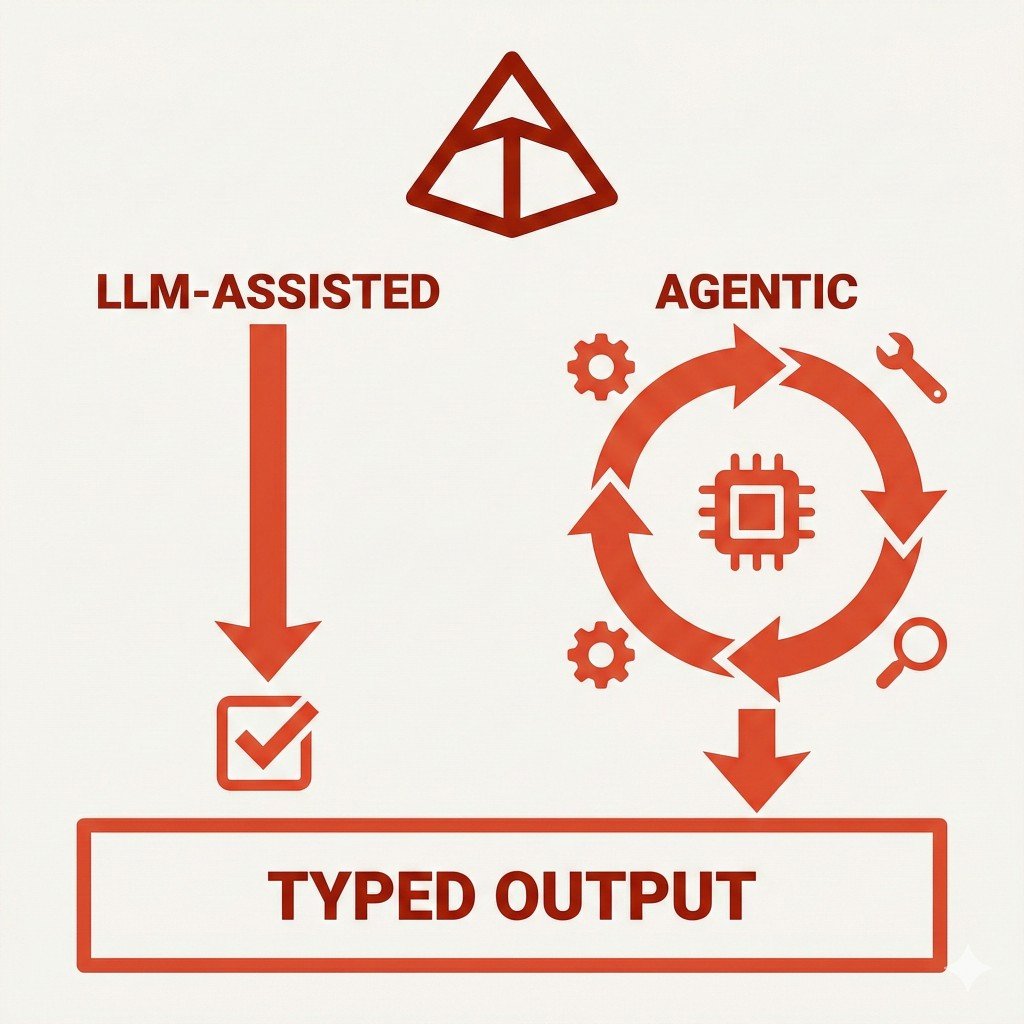
In Workflow or Agent I weigh keeping code in charge of a business automation against handing it to an agent. Either way the result is usually a mixed pipeline, and it needs clean seams between deterministic, LLM-assisted, and agentic steps. Pydantic models provide those seams.
Pydantic AI gives you one primitive — Agent — and lets you scale it across the spectrum:
- Deterministic: no agent at all, just code.
- LLM-assisted: an
Agentwith no tools. One LLM call, one validated output. - Agentic: an
Agentwith tools, timeouts, and a typed fallback.
The pipeline contract is the same in all three cases. Each step returns a Pydantic model, declared as output_type for the LLM-assisted and agentic variants. Whether the instance came from regular code, a single LLM call, or an agent that looped through five tool calls is local to that step.
LLM-assisted: a typed contract for a single call
Take a simple extraction task — pulling structured contact info from a free-text message like “Hi, I’m Anna Schmidt at anna@example.com, my customer ID is 12345.”
class ContactInfo(BaseModel):
    name: str | None
    email: str | None
    customer_id: str | None

extractor = Agent(
    model=model,
    system_prompt=EXTRACTOR_PROMPT,
    output_type=ContactInfo,
    output_retries=3,
)

result = await extractor.run(message_text)
# result.output is already a ContactInfo instance
If the model returns malformed JSON or a value that violates the schema, Pydantic validation fails and Pydantic AI retries — feeding the validation error back into the prompt so the model can correct itself. If it keeps failing, Pydantic AI raises, and the step’s runner catches it, as in the agentic example below. Downstream code doesn’t care whether the model nailed it first try or needed three attempts — it only ever sees a validated ContactInfo.
Agentic: same contract, more machinery
When a step needs to try a few strategies — for example, looking up a record when the extraction was ambiguous — the agent gets tools, but the output type doesn’t change.
fetch_agent = Agent(
    model=model,
    system_prompt=FETCH_AGENT_PROMPT,
    output_type=FetchResult,
    tools=[search_by_email, search_by_id, list_recent_contacts],
)

async def fetch_agent_run(info: ContactInfo) -> FetchResult:
    try:
        async with asyncio.timeout(10):
            result = await fetch_agent.run(info.model_dump_json())
            return result.output
    except Exception as e:
        log.warning("fetch agent failed", error=e)
        return FetchResult(record=None, error_code="AGENT_FAILED")
The output_type on the error path is still FetchResult: we construct one with record=None, so downstream code doesn’t need to special-case “did the agent work?” and sees the same shape either way. Agent runs also get an explicit timeout. An agent without a timeout is a production incident waiting to happen.
Deterministic: no agent at all, same shape
When a step doesn’t need an LLM, you don’t use one. But the function still returns the same type:
async def fetch_deterministic(info: ContactInfo) -> FetchResult:
    if info.customer_id:
        if record := await api.get_by_id(info.customer_id):
            return FetchResult(record=record)
    return FetchResult(record=None)
From the caller’s perspective, fetch_deterministic and fetch_agent_run are interchangeable.
What the shared contract buys you
Failure modes become typed values. Every way an LLM call can go wrong — malformed output, timeout, refusal, repeated validation failure — gets caught by the runner and turned into an instance of the step’s output type, like the FetchResult with an error_code above. The blast radius of “the LLM did something weird” stops at the runner for that step.
The agency-level decision becomes local. When a step you thought needed an agent turns out to be solvable with deterministic code, you delete the agent and keep the same output_type. When a step you thought was deterministic starts failing on edge cases, you swap in an agent without touching anything around it. The unit of change is one function.
If you’re curious what this looks like in a non-toy pipeline — one with intent classification, structured extraction, deterministic lookups, and an LLM-fallback planner all wired together — see Architecture of a First-Level Support Automation.