From Kernel Regression to Self-Attention: A Line-by-Line Derivation
·Reading time: 9 min
I have a mathematics background, and kernel regression is something I have studied deeply as part of advanced statistics.
Self-attention, on the other hand, felt slippery to me when I started learning it. It is confusing that the input tokens x play so many roles at once: they are queries, keys, and values.
Following §15.4 and §15.5.1 of Kevin P. Murphy’s Probabilistic Machine Learning: An Introduction, I will derive self-attention from kernel regression step by step. I keep Murphy’s notation where possible so the post can be read alongside the book.
Suppose we have n training pairs (x1,y1),…,(xn,yn) with xi∈Rd and yi∈R, and we want to predict y at a new test point x. The Nadaraya–Watson estimator says: take a weighted average of the training labels, where the weight given to yi depends on how similar x is to xi:
f(x)=i=1∑nαi(x,x1:n)yi(1)
Here αi(x,x1:n)≥0 are weights that sum to one (for any fixed x). A standard way to build them is to start from a density kernel. We will use the Gaussian:
Kσ(u)=2πσ21exp(−2σ2u2)(2)
where σ is called the bandwidth. We build the weights αi by normalizing the kernel across training points. Because of the normalization, the prefactor 1/2πσ2 is irrelevant and we drop it:
Comparing (3) with (4), the weights are exactly a softmax — applied to the exponent of the Gaussian, not to its value. We give that exponent a name. Define the attention score
This is still pure kernel regression — we have only rewritten it. Now observe that the Gaussian score in (5) plays one specific role here: it measures how similar x is to each xi. Nothing in the structure of (7) forces that particular choice. Letting a(x,xi) refer to a generic similarity score — not just the Gaussian one — gives
f(x)=i=1∑nsoftmaxi(a(x,x1),…,a(x,xn))yi(8)
Equations (7) and (8) are identical; only the meaning of a has widened. In (7) it is fixed to the Gaussian form (5); in (8) it is any real-valued function. The similarity function has become a pluggable component.
For now this is only a rename: ki=xi and vi=yi. In §7, the key and the value will both be the token xj, and §8 separates them again with learned projections.
so adding an i-independent constant to every score leaves the weights unchanged. The −∥q∥2/(2σ2) term is exactly such a constant and drops out. If we additionally assume all keys have the same norm, the third term −∥ki∥2/(2σ2) is also constant and drops out. What remains is a softmax-equivalent score — call it a~:
a~(q,ki)=σ2q⊤ki(12)
Because softmaxi(a(q,ki))=softmaxi(a~(q,ki)) for all i, we can replace a with a~ in (9) without changing any attention weight. This is the dot-product attention score. The bandwidth σ is still a free parameter; §5 determines its standard value.
In practice σ2=d, where d is the dimension of the query and key vectors, so the score (12) becomes a~(q,ki)=q⊤ki/d. The reason is statistical. Suppose the components of q and ki are independent, with mean zero and unit variance. Each product term qℓki,ℓ is then also mean-zero, with
Var(qℓki,ℓ)=E[qℓ2]E[ki,ℓ2]=1
Independence across ℓ means the variance of the sum is the sum of variances:
So the raw dot product has standard deviation d — it grows with dimension. Without rescaling, the scores spread further apart as d grows, the softmax saturates towards a one-hot vector, and its gradients vanish. Setting σ2=d gives the score unit variance, independent of d.
We now have all three ingredients: a softmax (6), a dot-product score a~ (12), and a 1/d rescaling. The whole pipeline vectorizes cleanly: stack the n queries, keys, and values as rows of matrices:
Q=q1⊤⋮qn⊤,K=k1⊤⋮kn⊤,V=v1⊤⋮vn⊤∈Rn×d
Then QK⊤ is an n×n matrix whose (i,j) entry is the raw dot product qi⊤kj; dividing by d gives the score a~(qi,kj) from §5. To see this concretely, consider n=3 tokens and d=2:
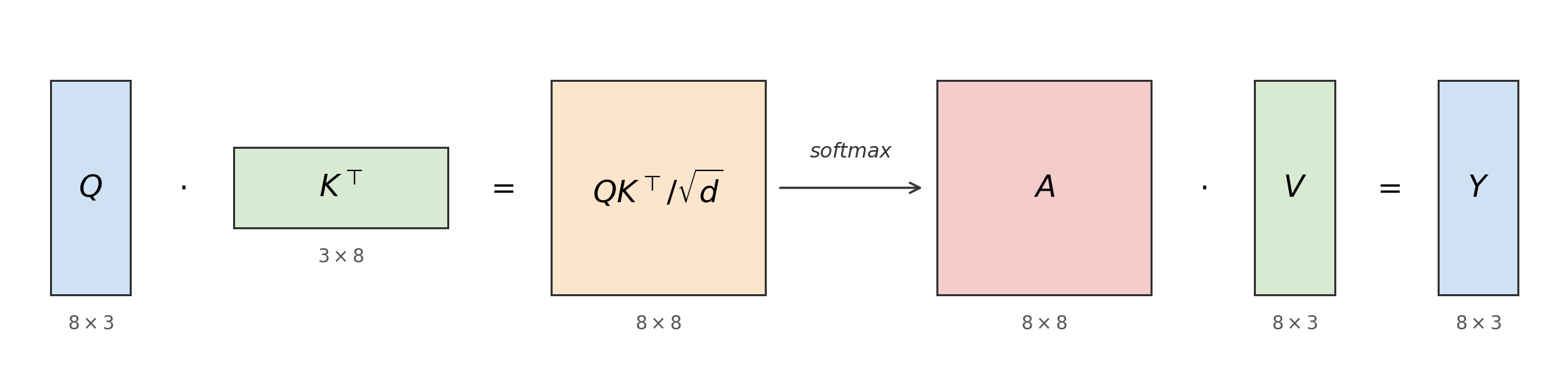
Row i holds all the scores that query i assigns to every key. Scaling by 1/d and applying softmax row-wise turns each row into a probability distribution — the attention weights for that query. Call this n×n matrix of weights A. Multiplying by V then takes a weighted average of the value rows for each query, giving the output matrix Y∈Rn×d. This is exactly (9) computed for all queries at once:
Y=Attn(Q,K,V)=softmax(dQK⊤)V(13)
This is scaled dot-product attention — the exact formula from “Attention Is All You Need” [Vaswani et al., 2017]. As a pipeline of matrix shapes:
The i-th row of Y is the output for query i: a context-weighted blend of all the values, where the weights are determined by how well query i matches each key.
So far we have been in the kernel-regression setting: each training point came with a scalar label yi, and the value in (9) was vi=yi. A Transformer processes something different — a sequence of tokens x1,…,xn with no labels attached. Every position has to supply its own payload.
Self-attention lets each token play all three roles. Every position attends to every other position in the same sequence, using the tokens themselves for queries, keys, and values:
yi=Attn(xi,{(xj,xj)}j=1n)(14)
This lets the model build context-dependent representations: in “the animal didn’t cross the street because it was too tired”, the output for it can draw mostly on animal, and with “too wide” mostly on street. And because there are no recurrences, all n outputs y1,…,yn can be computed in parallel — this is what makes Transformers so much faster to train than RNNs.
To let keys and values carry different information — and more broadly, to let the model learn what aspects of each token to match on and return — introduce three learned linear projections:
q=W(q)x,k=W(k)x,v=W(v)x(15)
The matrices W(q),W(k),W(v) are learned end-to-end by backpropagation. Plugging (15) into (14) gives the full self-attention layer used in Transformers:
yi=Attn(W(q)xi,{(W(k)xj,W(v)xj)}j=1n)(16)
This is the step that turns nonparametric kernel regression into a trained attention mechanism. The key/value split from §3 now earns its keep: because W(k) and W(v) are independent matrices, the vector a token is scored on, W(k)x, can differ from the vector it adds to the output, W(v)x.
Primary reference: Kevin P. Murphy, “Probabilistic Machine Learning: An Introduction”, MIT Press (2022). The kernel-regression-as-attention framing is developed in §15.4.2 (pp. 520–521) and the scaled dot-product score in §15.4.3; self-attention and the transformer architecture are covered in §15.5–15.5.2 (pp. 526–527). Available online at probml.github.io/pml-book/book1.html. Original transformer paper: Vaswani et al., “Attention Is All You Need”, NeurIPS 2017.
AI Chat
Messages you send are processed by the Google Gemini API to generate responses. Do not share sensitive personal data. See the privacy policy for details.